
White County Parole and Probation
Tennessee divides the key duties among three authorities. The Tennessee Board of Parole decides whether an eligible prisoner receives parole. A court orders probation. The Tennessee Department of Correction, or TDOC, supervises people on both forms of community release. That split explains why one office may decide a case while another office monitors it.
Parole means a person has left incarceration before the sentence expires and must follow Board conditions. Probation is a court-ordered form of community supervision used instead of confinement or after a suspended part of a sentence. Neither word means the case has ended. The person remains accountable to a supervision officer until discharge, expiration, or a new official action changes the status.
| Point | Parole | Probation |
|---|---|---|
| Who authorizes it | Tennessee Board of Parole | The sentencing court |
| Relation to custody | Follows physical incarceration | May replace or follow confinement |
| Who supervises | TDOC community supervision | TDOC community supervision |
| Best first public check | FOIL status and location | FOIL, then the court order |
| How it ends | Discharge or sentence expiration under the governing record | Court or TDOC record showing completion or discharge |
- Discharge
- The official end of supervision, not merely release from a jail or prison.
- Absconded
- A state status meaning the person failed to report to the assigned supervision officer.
- Inactive
- A FOIL status meaning the person is no longer under state supervision; it does not state why.
- Release plan
- The proposed residence and other arrangements that TDOC must approve before some parole releases occur.
Check White County Supervision Status
The official public starting point is TDOC Felony Offender Information Lookup, known as FOIL. It covers current and former felony offenders in TDOC custody or supervision. It does not serve as a full archive of White County misdemeanor cases or every person released from White County Jail. A court file may be essential when probation began without a state prison stay.
- Search FOIL by full name, TDOC ID, or State ID. Name search can include aliases and race, and the page uses a case-sensitive CAPTCHA.
- Match the result through identifiers before relying on it. An eight-digit TOMIS or TDOC number is stronger than a common name alone.
- Read the status and location together. Parole and probation identify supervision types, while the location may name the office handling the case.
- If FOIL says Inactive, seek the discharge or sentence record. Inactive alone does not identify the event or date that ended supervision.
- Call the listed supervision office to confirm where the person reports. For probation details, obtain the controlling order from the White County court file.
The FOIL search screen below shows the state’s name and ID routes.
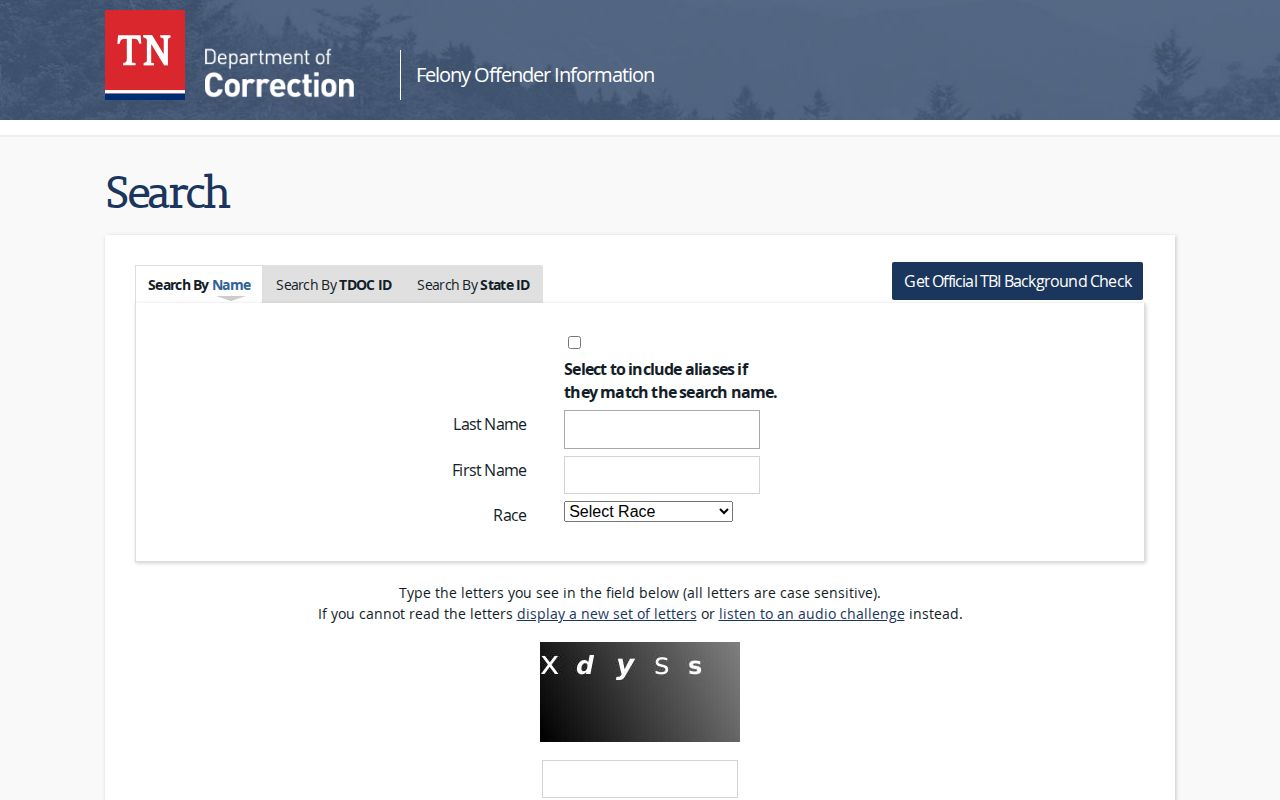
Use the result page only after confirming the correct person, then treat its agency status as one piece of the White County supervision record.
Note: A person absent from FOIL may still have a local case that must be checked with the sentencing court.
White County Parole Office Route
White County belongs to TDOC Community Supervision District 31. The state directory assigns White County and Cumberland County to a shared office in Crossville, while District 31 headquarters is in Cookeville. A White County residence does not prove that every person reports to the same desk. Transfers, case assignments, and the location shown in FOIL may point elsewhere.
Check the online location, then call before an in-person visit. The TDOC field-office directory is the source for both contacts.
White/Cumberland Community Supervision
29 Daniel Drive, Suite 103
Crossville, TN 38555
Phone: 931-484-1566
Fax: 931-707-0737
District 31 Office
851 South Willow Avenue, Suite 202
Cookeville, TN 38501
Phone: 931-526-7165
The state directory capture provides the local routing context.
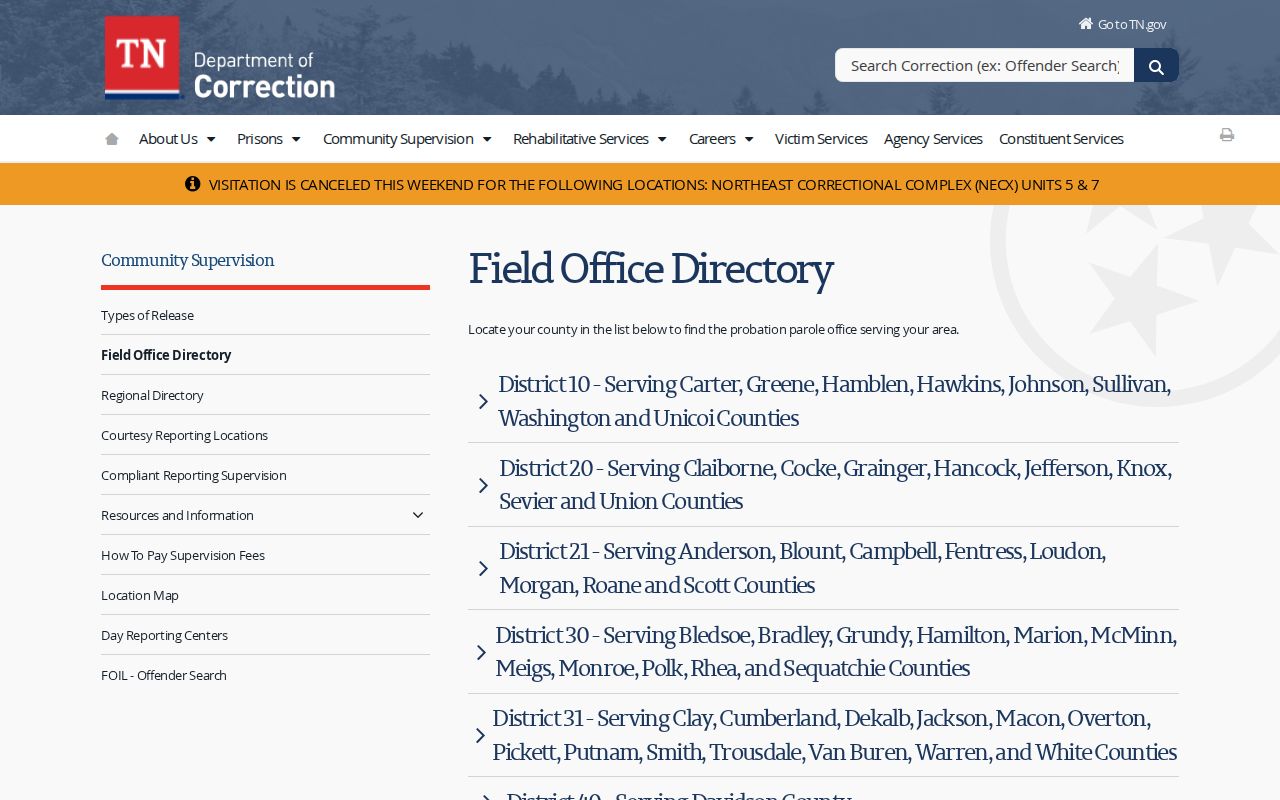
This two-office arrangement makes a confirming call more reliable than choosing a location solely from the person’s home county.
White County Parole Release Plans
A parole grant is not the same as physical release. TDOC states that a person granted parole remains confined until the probation and parole office approves the release plan and any required pre-parole conditions are complete. The Board hearing, the recommendation, the final decision, plan approval, and exit from the institution are separate events.
This distinction matters in a White County lookup. A Board record may support an authorization step but not show that the person reached the community. FOIL release information, the holding facility, VINE, and the TDOC release notice can establish later steps. The Board calls the first statutory threshold a Release Eligibility Date, or RED. It is a point at which release may be considered, not a promised departure date.
Note: Determinate release probation follows its own legal route and should be read from the controlling TDOC and court records.
White County Parole Hearing Records
The Tennessee Board of Parole publishes information about hearing types and offers current hearing schedules by email. Its page says schedules are updated weekly on Monday, or Tuesday after a Monday holiday. Requests go to BD.HearingSchedules@tn.gov. No standalone official public decisions-search page was identified during the White County research.
A schedule shows that a hearing is planned. It does not prove the result. The hearing officer’s recommendation, Board action, release-plan approval, and actual prison exit can occur at different times. For a decision question, use FOIL and contact the Board at 615-741-1150 or BOP.Webmail@tn.gov. The Board’s office is at 500 James Robertson Parkway, 4th Floor, Nashville, TN 37243-0850.
Hearing officers gather facts and make recommendations that are not binding on the Board. Board members may adopt, change, or reject those recommendations. The state page identifies grant hearings, preliminary revocation or probable-cause hearings, final revocation hearings, custodial hearings, rescission proceedings, time-setting hearings, and appeals. Those names mark different stages. A final revocation can result in revocation or reinstatement, while a rescission can withdraw a grant in the circumstances described by Board procedure.
Eligibility follows Tenn. Code Ann. § 40-35-501, with parole procedure in § 40-28-115. TDOC calculates RED and advises the Board when the threshold is met. Eligibility does not create a right to parole. Board guidance says some decisions need three concurring votes, most violent-offense decisions need four, and revocation decisions need two. A qualifying appeal based on significant new information, official misconduct, or significant procedural error generally must be requested within 45 days after notice of the final decision.
The Board hearing page shows the official schedule channel and hearing categories.
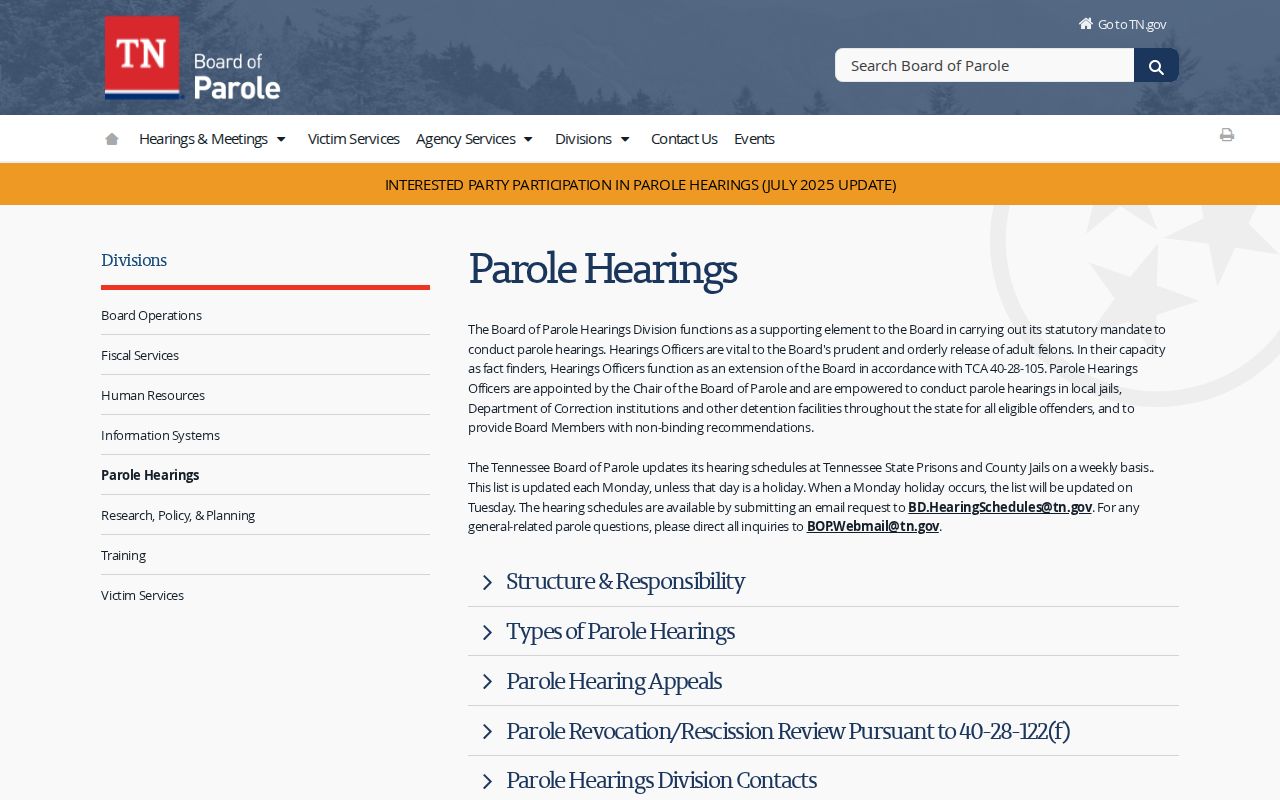
Use the schedule to identify the event, then obtain the later agency record needed to establish its outcome.
White County Supervision Violations
Supervision conditions come from the Board, TDOC, and the controlling court record. They can include reporting, approved residence, program participation, and other case-specific duties. The official order matters because a general list cannot establish what applies to one White County person. A violation allegation also does not by itself prove that supervision was revoked.
FOIL defines Absconded as failure to report to the assigned officer. That term should not be restated as proof of a public warrant. No official White County-specific online absconder or parole-warrant list was found. Confirm the state status through TDOC, the supervising office, the Board, or the responsible court. VINE can report a new custody event, but it is not a full supervision-condition file.
Does an Absconded status mean a warrant exists? Not necessarily from that status alone. Ask the supervising office or court for the record that shows any warrant, violation filing, or later disposition.
Property Proof After White County Release
Tennessee’s sheriff records schedule identifies a distinctive local release record: the receipt for property returned when a person leaves jail. CTAS series 12-027 calls for that receipt to be signed and witnessed and retained permanently. It may corroborate release administration after the White County online roster changes.
The property receipt is not a parole or probation status document. Nor does it replace the jail register or release order. The permanent jail register establishes commitment and release dates; the legal order explains the authority; a movement record can reveal transfer to TDOC or another custodian. The receipt is best used as a supporting record when the timing or physical release process is disputed.
Note: Request the record by person, booking, and approximate date so the White County custodian can locate an existing item.
White County Supervision Discharge
Physical release and supervision discharge occur at different points. A White County parolee may leave prison yet remain under TDOC oversight until the sentence or discharge action ends supervision. A person on probation remains bound by the court and TDOC record until completion, discharge, revocation, or another official change.
FOIL’s Inactive status means only that state supervision has ended. It does not reveal whether the cause was expiration, discharge, reversal, death, or another event. Read any sentence and release details that appear, check the court disposition, and request TDOC archived material when the date or basis matters. The broader White County released-inmate search and records path explains how the court file, jail register, and agency record fit together.
When an older FOIL entry lacks a clear discharge date, a TDOC archived-record request can use the full name, TOMIS number, and date of birth. The state archive route is more useful than guessing from the last known supervision location. For probation, the White County court file can show whether the court entered a completion, discharge, violation, or revocation order. Each source answers a different part of the timeline.
The strongest final proof is the agency or court record that actually ended supervision. Keep that record separate from an earlier jail release, Board grant, or eligibility date.